





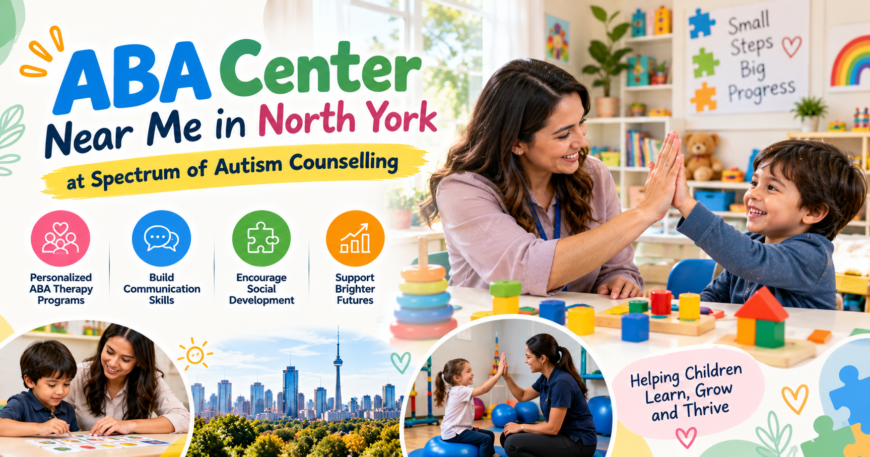
If you are searching for an ABA Center Near Me in North York, finding a clinic that combines individualized therapy, experienced clinical leadership, family involvement, and practical skill development is important. Applied Behavior Analysis (ABA) is a behavioral approach used to teach and strengthen useful skills by understanding how behaviors are influenced by their environment and what happens before and after them. The CDC identifies behavioral approaches, including ABA, as having substantial evidence for addressing symptoms and functional skills associated with autism.
Spectrum of Autism Counselling is an Ontario Autism Program (OAP)-approved provider based at 2201 Finch Ave W, Unit #5, Toronto, serving families in North York and the wider GTA. The organization describes its care as personalized and family-centered, with ABA/IBI therapy designed around communication, behavior, social skills, and independence.
For parents, the right ABA program is not simply about the number of therapy hours. It should address meaningful goals, measure progress, involve caregivers, and adapt as the child’s needs change.
What Is ABA Therapy?
Applied Behavior Analysis is a structured approach to understanding learning and behavior. ABA programs may be used to teach communication, social interaction, daily living, learning, and other functional skills.
The CDC explains that ABA encourages desired behaviors and tracks progress using measurement. Common ABA teaching approaches include Discrete Trial Training (DTT) and Pivotal Response Training (PRT), among others.
A quality program should translate this science into practical goals for the individual child.
For example, instead of setting a vague goal such as “improve behavior,” a therapy team may work on a measurable skill such as:
- Requesting a preferred item.
- Following a two-step instruction.
- Waiting for a turn.
- Completing a dressing routine.
- Participating in a classroom activity.
- Using an appropriate communication method.
- Increasing independence with daily routines.
This makes it easier for parents and clinicians to understand whether meaningful progress is occurring.
Why Choose an ABA Center Near Me in North York?
Location matters when therapy is part of a family’s regular routine. A nearby clinic can make appointments, parent participation, and communication with the therapy team easier to manage.
However, proximity should not be the only consideration.
When evaluating an ABA provider, parents should look at:
- Clinical leadership and qualifications
- Individualized treatment planning
- How progress is measured
- Parent involvement
- Communication with families
- Range of services
- Approach to sensory and communication needs
- Opportunities to generalize skills
- Program availability and scheduling
- Funding or program eligibility
Spectrum of Autism Counselling states that its North York clinic is led by a Clinical Director with BCBA, R.B.A., and more than 10 years of experience supporting children and families. The clinic also states that its therapists work under clinical supervision.
ABA Services Near Me: What Should Families Look For?
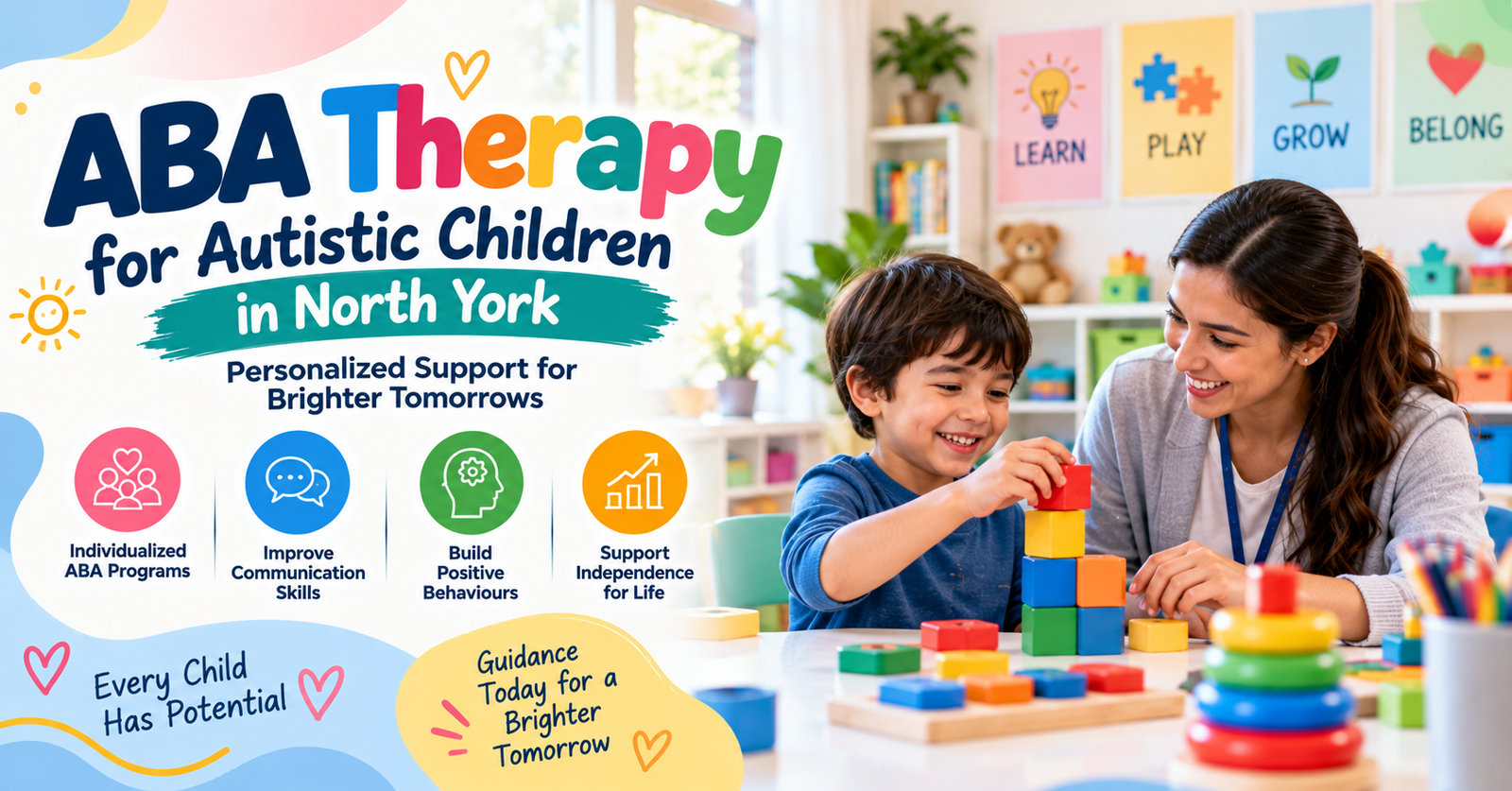
Parents searching for ABA Services Near Me should first identify the skills they want their child to develop.
A strong assessment should help answer questions such as:
- What does my child already do independently?
- Which skills are causing difficulty?
- How does my child communicate?
- What situations trigger challenging behavior?
- What motivates my child to participate?
- Which skills are most important for daily life?
- How can caregivers support learning at home?
This information can guide individualized goals.
Spectrum of Autism Counselling describes its ABA/IBI programs as personalized according to each child’s needs, with goals that can include communication, behavior, social skills, and independence.
Individualized ABA Therapy Matters
Autistic children have different strengths, communication styles, learning preferences, and support needs. A strategy that works well for one child may not work equally well for another.
Individualization can include:
Communication Goals
Some children may use spoken language, while others may communicate with gestures, pictures, sign language, or an electronic communication system.
Therapy can focus on helping the child communicate wants, needs, choices, and information using their most effective communication method.
Social Skills
Social goals may include:
- Taking turns.
- Initiating interaction.
- Responding to others.
- Following group routines.
- Understanding social cues.
- Participating in cooperative play.
Daily Living Skills
ABA-based teaching can also target practical independence, such as:
- Dressing.
- Eating routines.
- Personal hygiene.
- Toilet routines.
- Following household routines.
- Completing age-appropriate tasks.
The CDC notes that interventions for autism may target daily functioning and quality of life, and that occupational and behavioral approaches can contribute to independent living skills.
How ABA Can Support Communication and Learning
Communication is often one of the most important functional goals in autism therapy.
A therapist may break a complex communication skill into smaller steps. For example, if a child wants a snack, the learning sequence might involve:
Identify the item → approach an adult → use the preferred communication method → make the request → receive the item.
As the child becomes successful, the skill can be practiced with different people, items, and environments.
This type of structured teaching helps move a skill beyond one specific therapy activity.
The Importance of Parent Training
Parents are an essential part of a child’s learning environment.
A child may spend only part of the week in therapy. Most learning opportunities happen during everyday activities at home, school, and in the community.
Parent training can help caregivers understand:
- How to provide clear instructions.
- How to reinforce useful skills.
- How to respond consistently.
- How to support communication.
- How to encourage independence.
- How to collect useful observations about progress.
Spectrum of Autism Counselling lists Parent Training among its programs and describes it as workshops and one-on-one sessions designed to give parents strategies and tools to support development and manage challenging behaviors.
Measuring Progress in ABA Therapy
One of the important characteristics of behavioral intervention is measurement.
Instead of relying only on impressions such as “my child seems better,” clinicians can monitor specific behaviors or skills.
Examples include:
- Number of independent requests.
- Percentage of instructions completed.
- Duration of participation in an activity.
- Number of successful social interactions.
- Frequency of a target behavior.
- Level of prompting required.
- Independence with a daily routine.
The CDC notes that ABA-based behavioral approaches track and measure progress.
Why Data Matters
Data can help a clinical team determine whether a strategy is working.
If progress is limited, the team can investigate possible reasons and modify the teaching approach rather than continuing with the same strategy indefinitely.
Benefits of Working With a Local ABA Center
1. Consistent Professional Support
A local clinic can make regular sessions and communication with the therapy team easier to maintain.
2. Individualized Goals
Children can work on skills that are meaningful to their specific developmental needs.
3. Family Involvement
Parent coaching can help caregivers use consistent strategies outside therapy.
4. Skill Generalization
Children benefit when skills learned during therapy can be used at home, school, and in community settings.
5. Support Across Multiple Areas
Spectrum of Autism Counselling offers programs beyond ABA/IBI therapy, including social skills training, school readiness, parent training, after-school programs, respite services, ABA tutoring, and toilet training.
Pros and Considerations of ABA Therapy
Potential Benefits
- Structured and measurable learning goals.
- Individualized teaching strategies.
- Focus on practical and functional skills.
- Opportunities for caregiver participation.
- Progress can be monitored over time.
- Skills can be practiced across different environments.
Important Considerations
- Every child responds differently to intervention.
- Progress may vary between skills.
- Families need to remain involved for consistency.
- Goals should focus on meaningful quality-of-life and functional outcomes.
- Programs should respect the child’s communication style, preferences, dignity, and individual needs.
- Medical, developmental, speech-language, occupational, and educational needs may require collaboration with other professionals.
ABA should therefore be viewed as one component of a broader support plan when additional services are appropriate.
Practical Steps for Choosing an ABA Center Near Me
If you are comparing providers in North York, use this checklist.
Step 1: Identify Your Child’s Priority Skills
Write down three to five areas where you want support.
For example:
- Communication.
- Social interaction.
- Self-care.
- School readiness.
- Emotional regulation.
- Daily living skills.
Step 2: Ask About Assessment
Ask how the provider evaluates your child’s current skills and determines therapy goals.
Step 3: Ask How Progress Is Measured
A provider should be able to explain how progress is monitored and how treatment decisions are adjusted.
Step 4: Ask About Parent Involvement
Find out whether parents receive coaching, updates, and practical strategies to use at home.
Step 5: Ask About Generalization
Ask how skills are transferred from therapy sessions into everyday environments.
Step 6: Review the Full Service Range
A clinic offering complementary programs may make it easier to coordinate support as your child’s needs change.
Real-World Example: Building a Communication Goal
Imagine a child who frequently takes an adult’s hand to reach desired objects but rarely communicates the request independently.
A therapy team might begin by teaching a consistent functional request using the child’s preferred communication method.
The process could involve:
- Identifying a highly motivating item.
- Creating an opportunity for the child to request it.
- Providing an appropriate prompt when needed.
- Reinforcing the successful communication attempt.
- Gradually reducing prompts.
- Practicing the request with different people and items.
- Monitoring independent requests over time.
The long-term goal is not simply successful performance during a therapy session. The goal is useful communication that works in everyday life.
Why Early Support Matters
Early intervention can be valuable, but it is important not to assume that therapy is only useful for very young children.
The CDC states that early intervention services can improve development and that intervention can be helpful at any age.
This means families should focus on the child’s current needs rather than assuming that they have missed an opportunity because their child is older.
Spectrum of Autism Counselling states that its ABA/IBI programs serve children ages 2–15.
Spectrum of Autism Counselling in North York
Spectrum of Autism Counselling is based at 2201 Finch Ave W, Unit #5, Toronto, ON M9M 2Y9, serving families in North York and the wider GTA.
The organization describes itself as an Ontario Autism Program-approved provider and offers individualized ABA/IBI therapy alongside other autism-focused programs. Its website states that the clinic is led by experienced clinical leadership and provides family-centered support.
Its current program range includes:
- ABA/IBI Therapy
- Social Skills Training
- School Readiness
- Parent Training
- After-School Programs
- Respite Services
- ABA Tutoring
- Toilet Training
This broader service offering can be useful for families who need support across several developmental and daily-living areas.
Contact Information
Spectrum of Autism Counselling
2201 Finch Ave W, Unit #5
Toronto, ON M9M 2Y9, Canada
Phone: +1 365-654-2789
Email: info@spectrumautismcounselling.ca
Website: https://spectrumautismcounselling.ca/
Hours: Monday–Sunday, 9:00 AM–7:00 PM
Google Business Profile: https://maps.app.goo.gl/hjan7UjY7akU4Lsq8
Expert Recommendations for Parents
When selecting an ABA provider, parents should look beyond marketing language.
A practical evaluation should consider:
- Clinical qualifications: Understand who designs and supervises the program.
- Individualization: Goals should reflect the child’s needs rather than a generic checklist.
- Measurable outcomes: Ask how progress is recorded.
- Family participation: Parents should understand how they can support learning.
- Communication: Regular updates make collaboration easier.
- Functional goals: Prioritize skills that improve communication, independence, participation, and quality of life.
- Generalization: Ask how skills are practiced beyond the clinic.
- Child-centered care: Therapy should respect the child’s dignity, preferences, communication, and individual differences.
The Behavior Analyst Certification Board recognizes behavioral treatment of autism and other developmental disabilities as an ABA subspecialty, while the CDC identifies behavioral approaches including ABA as having substantial evidence for addressing autism-related symptoms and functional skills.
Choosing an ABA Center Near Me is an important decision for families seeking structured support for an autistic child. The right provider should combine qualified clinical oversight, individualized goals, measurable progress, parent involvement, and practical strategies that help children use their skills in everyday life.
For families in North York, Spectrum of Autism Counselling provides ABA/IBI therapy and a broader range of autism-focused programs from its Finch Avenue West location. Its family-centered approach is designed to support communication, behavior, social development, learning, and independence.
Families comparing an ABA Center Near Me should take time to discuss their child’s needs, understand the proposed goals, ask how progress will be measured, and learn how caregivers will be involved. A thoughtful, individualized plan can create a stronger foundation for meaningful developmental progress.
Frequently Asked Questions
1. What does an ABA center do?
An ABA center provides behavioral intervention based on principles of learning and behavior. Programs may target communication, social skills, daily living, learning, and other functional skills. ABA programs generally use individualized goals and measure progress over time.
2. How do I choose an ABA Center Near Me in North York?
Look at clinical qualifications, individualized treatment planning, progress measurement, parent involvement, communication, service availability, and how the provider supports skill generalization. Location is useful, but clinical quality and fit should also be considered.
3. What ABA Services Near Me does Spectrum of Autism Counselling provide?
Spectrum of Autism Counselling offers ABA/IBI therapy along with social skills training, school readiness, parent training, after-school programs, respite services, ABA tutoring, and toilet training. Current service availability should be confirmed directly with the clinic.
4. Does Spectrum of Autism Counselling serve children in North York?
Yes. Spectrum of Autism Counselling is based at 2201 Finch Ave W, Unit #5, Toronto, and states that it serves families in North York and the wider GTA.
5. Does ABA therapy only focus on behavior?
No. ABA can address many functional skills. Depending on the child’s goals, intervention may support communication, social interaction, learning, daily living, independence, and other meaningful skills. The CDC describes ABA as a behavioral approach used to improve a variety of skills.

Related Posts